Before buying lift kits and truck accessories in Reading, choose between a leveling kit and a complete suspension lift. A leveling upgrade corrects factory rake while preserving daily manners, and a suspension lift kit adds clearance, wheel travel, and larger tire fitment. Collect exact year, trim, drivetrain, and suspension specs to confirm Rough Country fit. Plan for tires, alignment, and accessories like steps, lights, or liners—you'll understand how the ideal setup develops.
Essential Information
- Opt for a leveling kit to eliminate factory rake while preserving near-stock handling and fitting bigger tires for daily use.
- Choose a suspension lift kit for increased ground clearance, wheel travel, and trail capability, recognizing that steering response may change.
- Check exact fitment with your truck's year, model, make, drivetrain, trim, cab, bed, and suspension system before buying Rough Country items.
- Align lift height and shocks with your needs, addressing commuting, mixed trail driving, towing, or heavier off-road travel.
- Budget for more than the kit price, covering alignment, labor, wheels, tires, shocks, and add-on accessories like steps, lights, and liners.
Suspension Lift Kits Against Leveling Kits
While both upgrades change your truck's appearance, suspension lift kits and leveling kits address different problems and deliver different outcomes. A leveling upgrade usually raises the front to match the rear, correcting factory rake with little change to geometry, ride height, and daily drivability. You use one when you want a cleaner look and room for slightly larger tires.
A suspension lift raises the whole truck and modifies key components to produce more ground clearance and suspension travel. You'll see bigger gains in ride height, off-road capability, and tire fitment, but you should expect handling changes, steering differences, and a raised center of gravity. If you want subtle visual improvement, level it. If you need real clearance and articulation, use a suspension lift and plan the supporting modifications based on your needs.
Determine which Rough Country lift kit is right your truck.
To determine the best option, start with your truck's year, manufacturer, and model, drivetrain, and planned application, because Rough Country builds lift kits around exact structural design and performance goals. That baseline tells you which suspension components, brackets, and hardware will actually bolt on without clearance or geometry problems.
Then check original ride height, cab layout and bed setup, axle setup, and whether your truck features 2WD, 4WD, or adaptive suspension. Rough Country fitment guides help with this verification, although you have to validate model compatibility versus configuration-specific parts and factory package variations. A kit designed for a Silverado 1500 may not fit a Trail Boss, and a Ram featuring air suspension demands different accommodations compared to a coil-spring vehicle. After checking fitment thoroughly, you avoid unexpected problems, compatibility issues, and return delays.
Find the Rough Country lift kit that suits your driving style.
Align the kit with your actual driving habits, and you'll enjoy enhanced ride quality, durability, and tire clearance without paying for features you won't need. If your truck spends most days commuting, select a basic Rough Country leveling kit or a 2 to 3.5 inch lift kit designed for commuting comfort and predictable steering geometry.
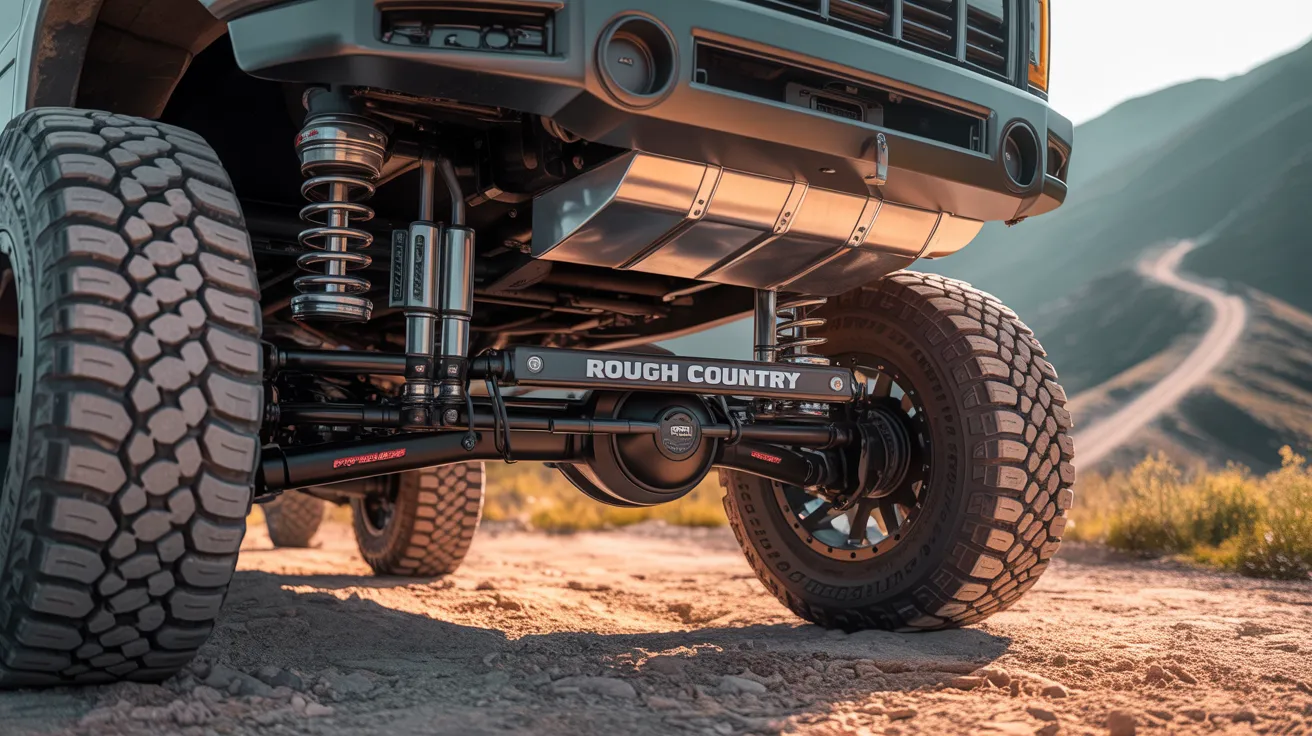
When you alternate between pavement and trails, step up to a suspension lift that includes premium shocks and corrected control arm angles. You'll achieve enhanced off-road performance, enhanced articulation, and clearance for larger tires without overstressing stock components. For extensive off-road use, select lifted shock struts, Rough Country N3 or Vertex dampers, and setups that keep driveline angles correct under compression. The right Rough Country package should align with load capacity, speed, and terrain, and your tolerance for ride stiffness.
Leading Rough Country Truck Accessories
Enhance your new lift system using Rough Country upgrades that solve the actual issues you'll see once you lift it and add bigger tires. Start with new running boards or side sliders, which bring back cabin access and offer lower-vehicle protection now that your truck sits higher and broader.
focus
What Budget Should You Plan for Your Build?
After selecting the lift kit and supporting accessories, allocate a budget beyond the base price. You'll require money for shocks, wheels, tire options, alignment work, labor, and any drivetrain or steering corrections your platform requires. Maker reputation matters; premium systems usually offer tighter tolerances, better ride quality, and easier installations.
Regarding realistic budget ranges, expect entry-level spacer or leveling setups to begin lower, while full suspension systems with control arms, tuned dampers, and larger tires rise quickly. Install complexity, summary labor costs, and calibration services can add substantially. You should also price supporting upgrades like gear changes, brake components, and recovery gear if you intend for off-road use. When budget is tight, compare financing options carefully and prioritize consistency over flashy add-ons.
Frequently Asked Questions
Can Lift Kits Affect Factory Warranty Coverage?
Yes, lift kits could impact your factory warranty coverage, yet they won't necessarily void it. You may face warranty problems if a dealer proves the lift kit triggered or contributed to a breakdown. Powertrain, steering, suspension, and drivetrain claims commonly cause dealer disputes. You should keep installation documents, select quality parts, and follow service intervals. That helps you dispute declined claims and preserve protection if the modification wasn't responsible.
Do Bigger Tires Mean Re-Gearing?
Yes—if you jump multiple tire sizes, you'll typically require re-gearing. For instance, when switching from 31s to 35s, your truck may feel slow, hunt for gears, and put strain on the drivetrain under load. Re-gearing reestablishes effective gear ratios, helping you restore acceleration, towing performance, and transmission behavior. You might not need regearing for modest tire increases, however, if performance, fuel mileage, or gear shifting decline, it's usually the right call.
How Often Should Lift Kit Components Be Inspected?
You must examine lift kit components once 500 miles are reached, then at every oil change or 3,000 to 5,000 miles, subject to use. Routine inspections help you notice bushing wear, leaking shocks, bracket issues, and alignment problems soon. Check Fastener torque after hard off-road runs, towing, or impacts. If you drive in mud, salt, or rough terrain often, shorten intervals and look at suspension and steering components more frequently.
Can a lift kit change your truck's towing and payload performance?
Yes, a lift kit can affect your truck's towing and payload abilities. When you raise ride height for more ground clearance, you transform suspension angles, center of gravity, and component loading. That can decrease stability under load and increase drivetrain stress, particularly when using larger tires. You should obey your manufacturer's ratings unless an certified engineered kit clearly details upgraded ratings. Proper alignment, gearing, and brake effectiveness matter too.
Are wheel alignment Required After Installing Truck Accessories?
Yes—if accessories alter ride height, suspension geometry, steering position, or tire circumference, you require an alignment service. You'll feel the theory instantly: slight changes can pull your truck off-center, scrub tread, and affect handling response. A proper wheel alignment realigns camber measurement, caster, and toe measurement to standard specs. After certain installs, you may also need brake adjustment for electronic driver aid accuracy. You maintain tire mileage, steering precision, and practical safety by checking alignment immediately.
Conclusion
Picking the ideal lift package and components comes down to how you use your truck, what stance you want, and what your budget can handle. When you match a Rough Country kit to your driving style, you'll get power, ground room, and style which coordinate as efficiently as a calibrated engine. Add smart accessories, organize your budget responsibly, and you'll assemble a pickup that's reliable for streets, powerful off-road, and set for any future work.